What is an Analemma?
The figure-eight the sun traces in the sky over a year
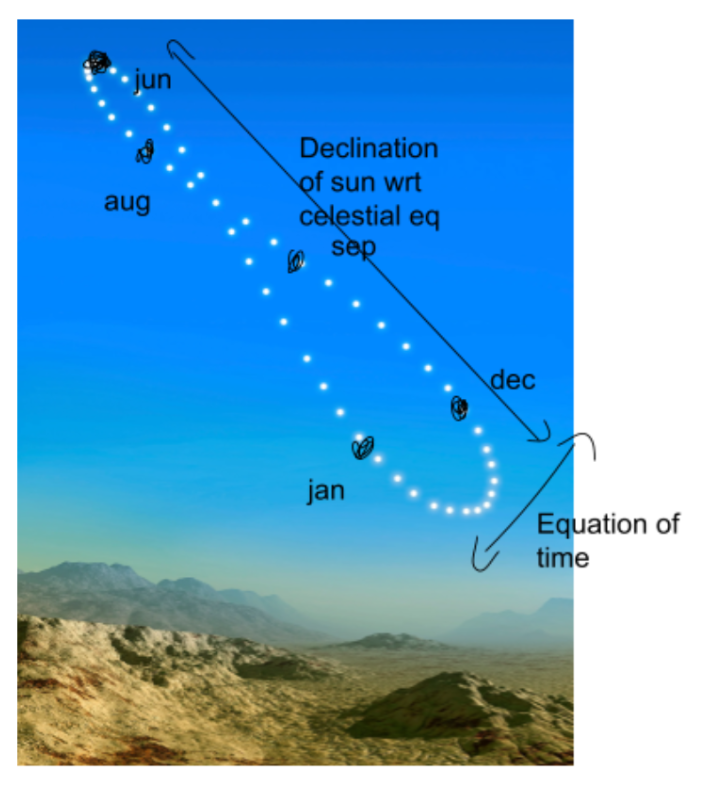
If you photograph the sun from the same spot, at the same time of day, every week for an entire year, the sun won't be in the same place. It drifts. Over twelve months those positions trace out a tall, narrow figure-eight called an analemma.
This feels wrong at first. Intuitively the sun "should" be in the same spot at noon every day. But the Earth's orbit isn't circular, and its axis is tilted 23.44 degrees off vertical, and those two facts together are enough to produce the pattern.
Why does it happen?
The figure-eight comes from two independent effects layered on top of each other.
Axial tilt is the more intuitive one. Because Earth's rotation axis is tilted relative to its orbital plane, the sun's declination (its angular height above or below the celestial equator) swings between +23.44 and -23.44 degrees over the course of a year. Higher in summer, lower in winter. That oscillation gives the analemma its vertical extent.
Orbital eccentricity is subtler. Earth's orbit is slightly elliptical, so it moves faster near perihelion (early January) and slower near aphelion (early July). The practical effect is that the sun doesn't cross your local meridian at exactly noon every day. The deviation, called the Equation of Time, can be as large as 16 minutes. It shifts the sun east or west of where a perfectly regular clock would predict, which creates the horizontal width of the figure-eight and makes the two lobes asymmetric.
Neither effect alone makes a figure-eight. Tilt alone would give you a vertical line; eccentricity alone, a horizontal oscillation. It's the combination that produces two loops of different sizes, with the top lobe typically smaller because perihelion and the winter solstice fall only about two weeks apart.
Does it look the same everywhere?
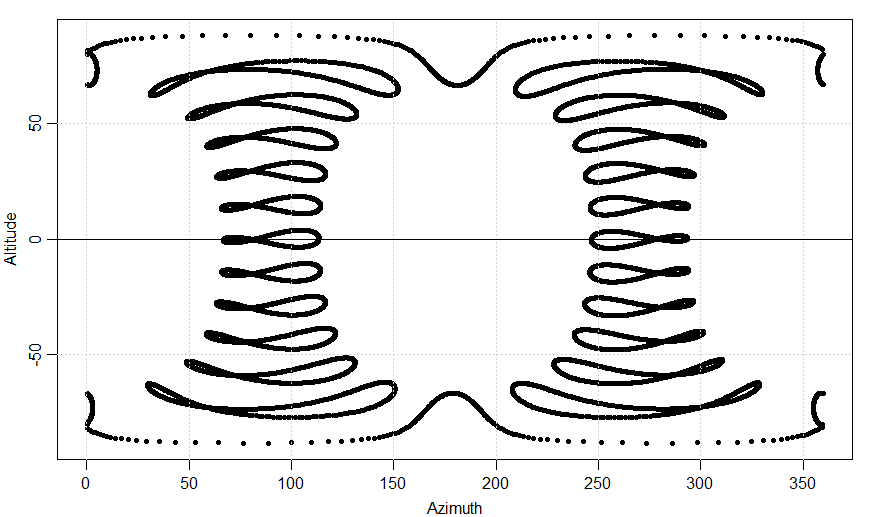
The shape is identical from anywhere on Earth, since it's entirely determined by orbital mechanics. But its orientation and position in the sky change a lot depending on where you are and what time of day you're photographing.
At the equator around noon, the analemma stands nearly vertical, centered high overhead. At mid-northern latitudes (say, 40 N) a noon analemma tilts toward the south. Photograph it at sunrise or sunset and the whole thing rotates sideways, sometimes dipping partly below the horizon. In the southern hemisphere the larger lobe ends up on top instead of the bottom.
Other planets
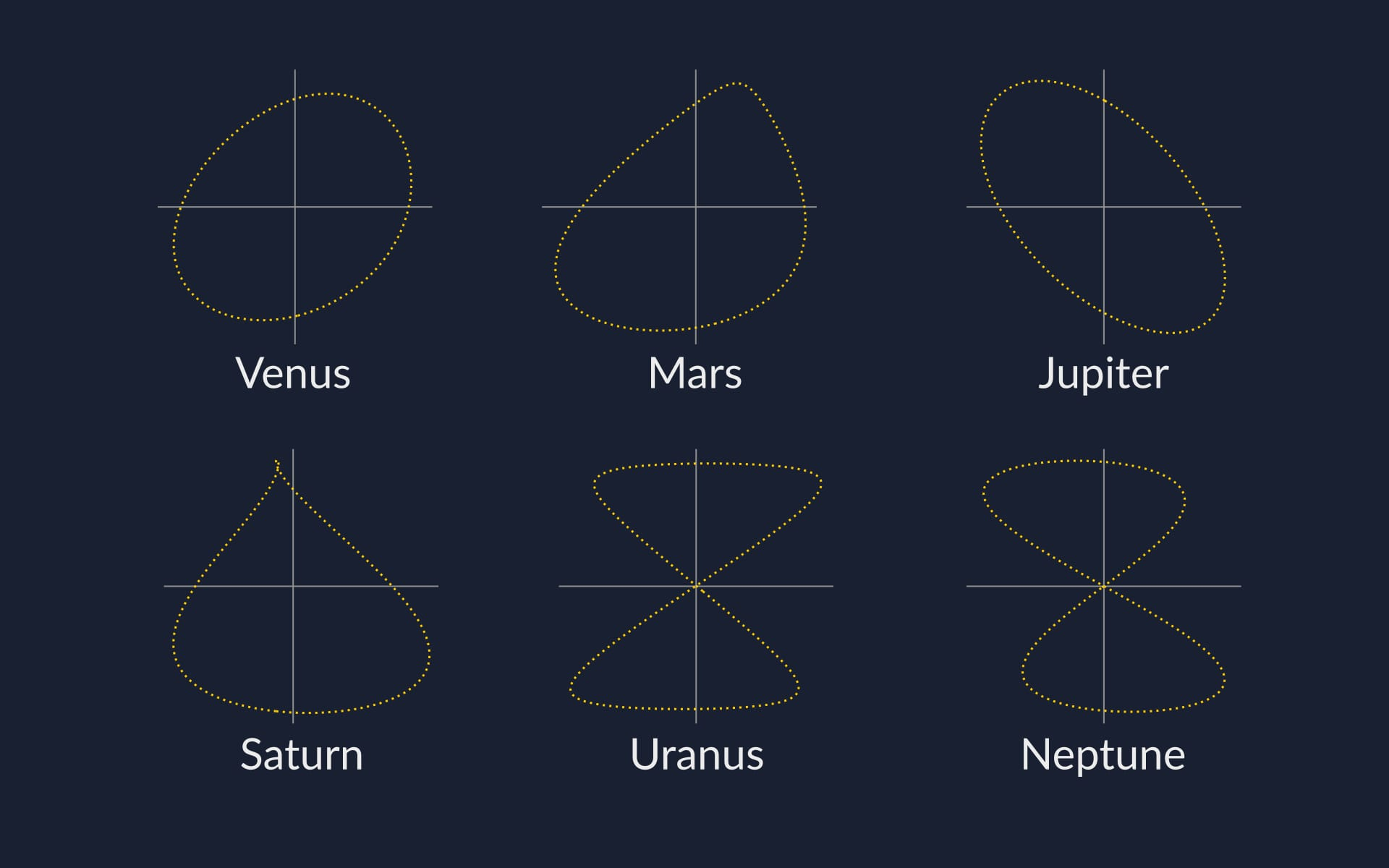
Every planet with a tilted axis or an eccentric orbit has some version of an analemma. Mars makes a teardrop rather than a figure-eight because its orbit is far more eccentric than Earth's. A hypothetical planet with zero tilt would trace a horizontal line; one with a perfectly circular orbit but nonzero tilt would give you a symmetric figure-eight with equal-sized lobes.
What this app does
Analemma Vision computes the sun's position for every day of the year at your chosen time and location, using high-precision JPL DE440 ephemeris data through Astropy. It then projects those positions onto your photograph with a tangent-plane camera model built from the photo's focal length and sensor dimensions, and the result is a precise analemma curve rendered directly on your sky.
Upload any photo with the sun in it. The app will try to detect the sun automatically; if that doesn't work (overcast, lens flare, the sun is behind clouds), you can click to select its position manually.
